

A step-by-step guide to onboarding new hires—from pre-boarding paperwork to the first 90 days.
Hiring someone new is exciting. But between paperwork, system access, compliance requirements, and first-week logistics, it’s easy for things to slip through the cracks.
A missed document delays payroll. A forgotten system account leaves the new hire idle on Day 1. A disorganized first week turns excitement into confusion.
This checklist covers everything you need to handle when onboarding a new employee—organized by phase so nothing gets missed.
Why a Structured Onboarding Checklist Matters
Companies with structured onboarding see up to 82% higher retention and 70% faster time-to-productivity. But beyond the numbers, there’s a simpler reason: onboarding involves dozens of tasks across multiple teams, and without a checklist, things fall through the cracks.
HR handles documents. IT sets up accounts. The hiring manager plans the first week. Finance processes payroll. When everyone assumes someone else is handling it, new hires suffer.
A checklist creates accountability. Every task has an owner, a deadline, and a clear status.
Pre-Boarding: Before Day 1
The best onboarding starts before the new hire’s first day. Use the time between offer acceptance and start date to handle paperwork and logistics so Day 1 can focus on people, not forms.
Documents to collect:
- [ ] Government-issued ID copy
- [ ] Tax identification number and tax forms
- [ ] Bank account details for payroll
- [ ] Emergency contact information
- [ ] Signed employment contract
- [ ] Non-disclosure or confidentiality agreements (if applicable)
- [ ] Benefits enrollment forms
- [ ] Educational certificates (if required)
Internal preparation:
- [ ] Set up workstation—laptop, monitor, peripherals
- [ ] Create email account and system credentials
- [ ] Provision access to required tools and platforms
- [ ] Prepare welcome kit and employee handbook
- [ ] Assign an onboarding buddy or mentor
- [ ] Notify the team about the new hire and start date
- [ ] Schedule orientation meetings for the first week
- [ ] Prepare building access card or security badge
Day 1: Set the Tone
Day 1 shapes how a new hire feels about your company. Keep it structured but welcoming—they should leave feeling informed and excited, not overwhelmed and lost.
Morning:
- [ ] Welcome and introductions with immediate team
- [ ] Office tour—facilities, meeting rooms, kitchen, emergency exits
- [ ] Review company mission, values, and culture
- [ ] Walk through the employee handbook
- [ ] Verify all pre-boarding documents are complete and signed
Afternoon:
- [ ] IT setup walkthrough—email, chat, project tools, VPN
- [ ] Review role expectations and initial goals with manager
- [ ] Explain communication norms—when to email vs. chat vs. meet
- [ ] Share organizational chart and key contacts
- [ ] Provide the first-week schedule
First Week: Build Context
The first week is about understanding. The new hire should learn how things work, who to go to for what, and what success looks like in their role.
- [ ] Complete mandatory training—security, data privacy, company policies
- [ ] Shadow key team members to understand workflows
- [ ] Review current projects and team priorities
- [ ] Set up regular 1-on-1 check-ins with manager (weekly recommended)
- [ ] Confirm all system access is working correctly
- [ ] Introduce to cross-functional stakeholders
- [ ] Register for payroll and benefits (if not completed pre-boarding)
HR compliance check: Ensure all legally required registrations (tax, social security, insurance) are submitted within their respective deadlines. These vary by country—verify your local requirements.
First 30 Days: Learn and Adapt
- [ ] Complete all required compliance and role-specific training
- [ ] Understand team goals and individual KPIs
- [ ] Attend key recurring meetings
- [ ] Build relationships with cross-functional contacts
- [ ] Begin contributing to small tasks or projects
- [ ] End-of-month check-in with manager: gather feedback, address concerns, adjust expectations
Days 31–60: Contribute
- [ ] Take ownership of initial assignments
- [ ] Participate in team projects with increasing independence
- [ ] Identify process improvements or areas of confusion
- [ ] Mid-point review with manager: track progress against goals
- [ ] Expand network across departments
Days 61–90: Integrate
- [ ] Operate independently in core responsibilities
- [ ] Complete probationary review (if applicable)
- [ ] Confirm ongoing employment status
- [ ] Set goals and development plan for the next quarter
- [ ] Final onboarding review: what worked, what didn’t, what to improve
Common Mistakes to Avoid
Information overload on Day 1. Spread orientation across the first week instead of cramming everything into eight hours.
No buddy or mentor. New hires with a designated buddy ramp up faster and feel less isolated. It doesn’t need to be formal—just someone they can ask “stupid” questions to.
Ignoring the pre-boarding window. The days between offer acceptance and Day 1 are wasted if you don’t use them. Handle paperwork early so the first day is about connection, not administration.
One-size-fits-all onboarding. A senior engineer and a junior marketing hire need different onboarding paths. Customize where it matters.
No check-ins after Week 1. Onboarding doesn’t end on Friday of the first week. The 30-60-90 day structure exists because integration takes time.
Free Downloadable Checklist
We’ve compiled everything above into a single-page checklist you can print and reuse for every new hire.
Download the Onboarding Checklist (PDF) →
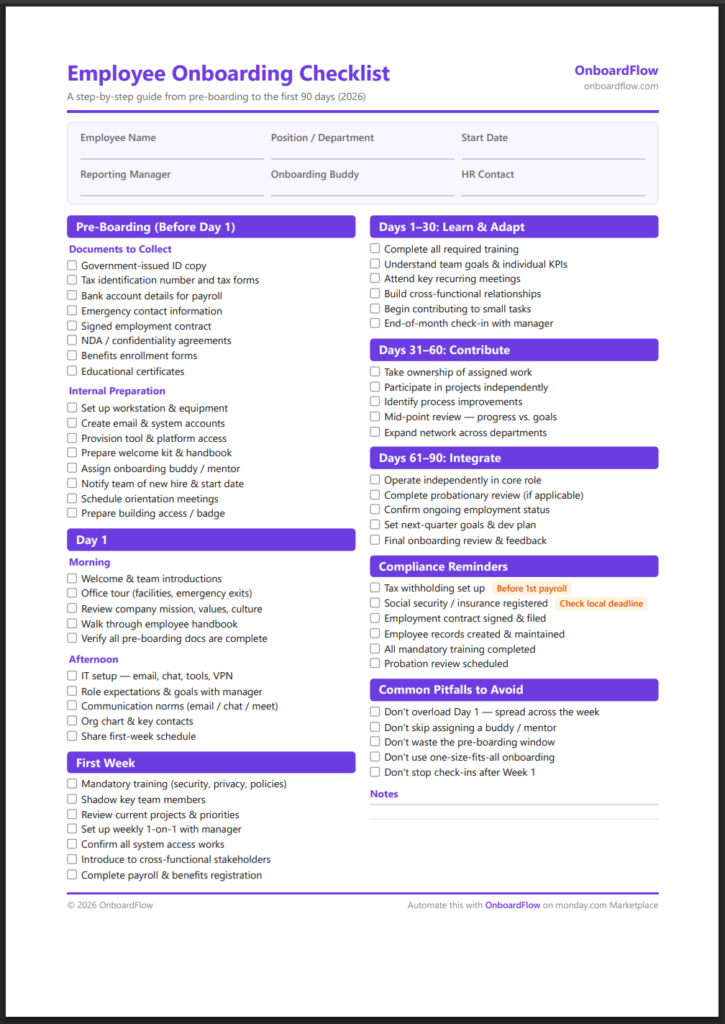
Customize it for your company’s specific requirements and local regulations.
Stop Managing Onboarding in Spreadsheets
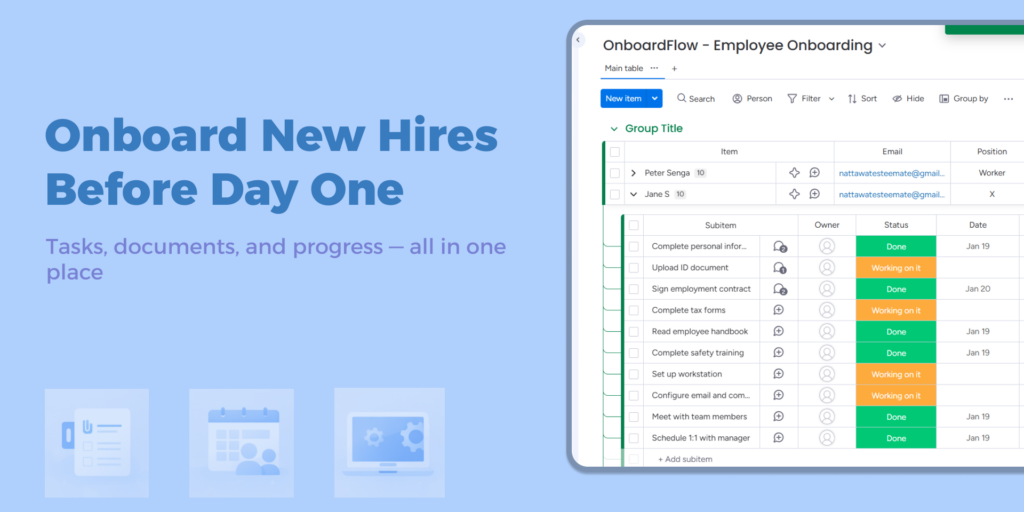
Checklists are a great starting point. But when you’re onboarding multiple people at once, tracking everything across spreadsheets, emails, and chat messages gets messy fast.
OnboardFlow automates the entire process:
- HR manages onboarding in monday.com—create templates, track progress, review documents, all in one workspace
- New hires use a simple mobile app—clear task lists, easy document uploads, push notification reminders
- Everything syncs automatically—no manual follow-ups, no lost documents, no missed deadlines
Your HR team gets operational control. Your new hires get a consumer-grade experience. Compliance deadlines get met without the scramble.
Try OnboardFlow on the monday.com Marketplace →
OnboardFlow is an employee onboarding app that integrates directly with monday.com. Available on the monday.com Marketplace.